
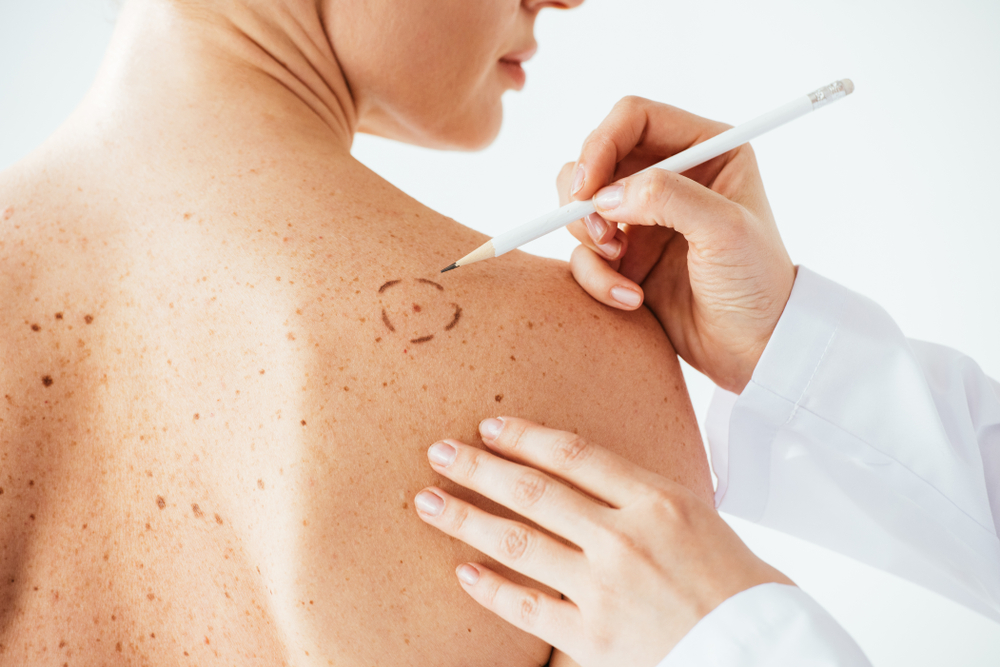
Knowing the warning signs of melanoma in Arlington, Virginia, and understanding your individual risk factors can play an important role in detecting this serious form of skin cancer early.
What is Melanoma?
Melanoma is a serious form of skin cancer that begins in melanocytes, the cells responsible for producing the pigment that gives skin its color.
It develops when changes occur in a melanocyte’s DNA, causing the cell to grow and multiply in ways healthy cells do not.
How Does it Compare to Other Forms of Skin Cancer?
Compared with basal cell carcinoma and squamous cell carcinoma, melanoma is far less common, but it carries significantly higher risk because of how quickly it can spread to other parts of the body.
Most cases are linked to ultraviolet exposure from the sun or tanning devices, though melanoma can occasionally develop in areas that receive little sun exposure.
That being said, when detected and treated early, melanoma is often curable. The estimated five-year survival rate for melanoma detected in its earliest stages is approximately 99%.
Melanoma can appear as a new dark spot or as a change to an existing mole. Because melanoma does not always follow the same pattern, any new or changing spot on the skin is worth having evaluated.
What Are the Melanoma Warning Signs?
Melanoma is common on sun-exposed parts of the body. However, it can occur anywhere and present in different shapes, sizes, and colors.
As such, it is important to conduct monthly self-exams and use the ABCDE guide to help detect these warning signs.
When inspecting your body from head to toe, including under nails, in between toes, on the palms of your hands, and on the soles of your feet, look for lesions that exhibit:
A – Asymmetry: Asymmetrical appearance
B – Border: Borders that are uneven, notched, or scalloped
C – Color: Multiple colors with different shades of brown, black, or tan
D – Diameter: Diameter that is larger than the size of a pencil eraser (approximately 6 mm)
E – Evolution: Evolution in size, shape, color, and elevation
Because melanoma does not always follow this pattern, any new or changing spot on the skin is worth having evaluated.
When Melanoma Develops and Who Is at Risk
Melanoma can develop at any age, though the risk increases with cumulative sun exposure over the years, including sunburn that occurred decades earlier.
A personal or family history of melanoma also raises the likelihood of developing it, along with having a higher-than-average number of moles.
Fair skin, light-colored eyes, and a tendency to freckle or burn easily are several risk factors that further increase susceptibility, as does a weakened immune system from certain medications or medical conditions.
Where melanoma tends to appear can also differ from person to person, often showing up on the trunk or upper back in men and on the legs in women.
In people with darker skin tones, melanoma is more likely to develop in less sun-exposed areas, such as the palms, soles, or beneath a fingernail or toenail, which makes these spots easy to overlook during a routine self-check.
Regular self-checks and professional screenings help catch these less obvious cases before they progress.
What Are the Different Types of Melanoma in Arlington, Virginia?
There are four types of melanoma, including:
- Superficial Spreading Melanoma
The most common type of melanoma. It can develop from a new mole or an existing mole. In the latter case, it is likely to grow on the surface of the skin for some time before penetrating deeper.
- Lentigo Maligna
It presents similarly to superficial spreading melanoma and often occurs on sun-damaged skin.
- Acral Lentiginous Melanoma
This type of melanoma often occurs on hard-to-spot areas and is the most common form of melanoma diagnosed in individuals with skin of color.
- Nodular Melanoma
It is the most aggressive form of melanoma and grows deeper and more rapidly than the others.
How Melanoma Is Diagnosed and Treated
When a suspicious spot is identified, a biopsy is typically performed to confirm whether melanoma cells are present and, if so, how deeply they extend into the skin.
This information determines the stage of the melanoma, which guides every decision that follows in the treatment plan.
Surgical removal of the melanoma and a margin of surrounding healthy skin remains the primary treatment for early-stage cases and can often be performed in an outpatient setting.
More advanced cases may require additional treatments, such as targeted therapy, immunotherapy, or radiation, depending on how far the melanoma has spread.
Melanoma caught in its earliest stages has a high rate of successful treatment, with survival estimated at around 99% when it has not spread beyond the skin.
Because melanoma can recur, ongoing skin checks remain an important part of care even after successful treatment.
Why Choose Dr. Yousefi for Melanoma in Arlington, VA
Marjan Yousefi, M.D. is a board-certified dermatologist and Fellow of the American Academy of Dermatology, training that supports precise identification of melanoma and the many benign spots that can resemble it.
Distinguishing between the two accurately is essential, because unnecessary biopsies and missed diagnoses both carry real consequences.
A thorough skin examination takes your personal risk factors, prior sun exposure, and family history into account, rather than relying on a single visual check alone.
For those uncertain about a new or changing spot, knowing when a mole warrants a closer look can help guide the decision to schedule an evaluation sooner rather than later.
Ongoing monitoring after treatment, along with guidance on sun protection and self-exams, helps reduce the risk of developing new melanoma in the future. Recognizing when a changing lesion needs urgent attention can make a meaningful difference in how early it is caught.
Schedule a Skin Cancer Screening for Melanoma in Arlington, VA
Melanoma in Arlington, VA, is most treatable when caught early, which is why regular skin checks matter in a region where outdoor activity is part of daily life.
Contact us online or call 703-255-5070 to schedule a skin evaluation with Marjan Yousefi, M.D. New and existing patients can also book an appointment online