The trouble with basal cell carcinoma is how easy it is to overlook.
As the most common form of skin cancer, it accounts for an estimated 3.6 million U.S. cases each year.
It can pass for a stubborn pimple, a sore that keeps reopening, or a scar with no injury behind it.
Most cases are curable, and a dermatologist who catches one early has the best chance of removing it before it causes lasting damage.
A Pearly Bump, a Scaly Patch, or a Sore That Won’t Heal
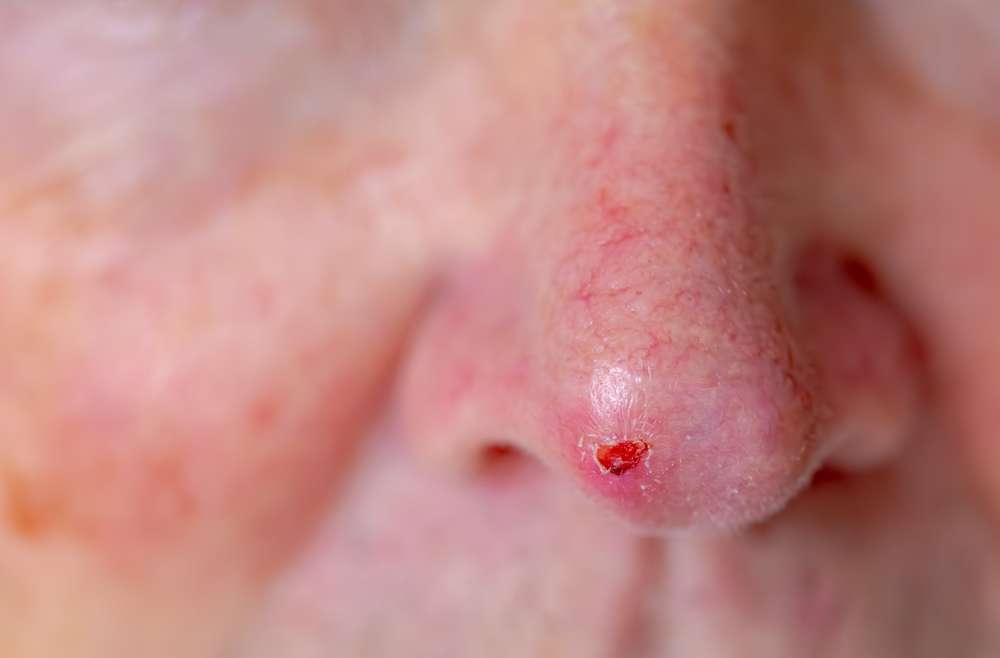
Most people picture skin cancer as a dark, irregular mole. Basal cell carcinoma usually takes a quieter form, most often a firm, round, raised growth. Other forms include:
- A shiny bump with a slightly raised, rolled border
- A round spot that sinks in at the center
- A flat, scaly patch that slowly grows larger
- A waxy, scar-like mark that appears without injury
- A sore that heals, then returns in the same place
Color varies with skin tone. On lighter skin, the growth is often pink or red, while darker skin tends to show brown, black, or bluish growths.
In people with deep skin tones, about half of these cancers carry pigment, which can make them look like an ordinary mole.
Why Sun-Exposed Skin Is the Usual Starting Point
Ultraviolet light from the sun and tanning beds damages the DNA in basal cells, the cells that produce new skin. Over time, that damage can trigger uncontrolled growth.
The head and neck are the most common sites, including the ears, nose, eyelids, and scalp. Growths can also form on the chest, back, shoulders, arms, and lower legs.
A history of severe sunburns, a weakened immune system, or a family history of skin cancer can raise your risk.
Basal cell carcinoma also becomes more common with age, though doctors increasingly diagnose it in people in their 20s and 30s.
Basal Cell Carcinoma: A Slow Grower That Can Still Run Deep
Basal cell carcinoma tends to take its time to develop. It rarely spreads beyond its original site, which sets it apart from melanoma.
Slow growth still adds up. Left untreated, the cancer can extend into nearby tissue and bone and become disfiguring.
Delays also raise the chance that it returns after treatment, sometimes more than once.
As the spot enlarges, it may bleed, crust, or break open, especially where clothing or jewelry rubs against it. Itching, numbness, or tenderness in the area also calls for an exam.
How Basal Cell Carcinoma in Arlington, VA, Is Diagnosed and Treated
No photo can confirm basal cell carcinoma, however closely a spot resembles a picture online.
A dermatologist first studies the spot through dermoscopy, a magnified view that reveals tiny blood vessels and patterns beneath the surface.
A lab then examines a small biopsy sample to confirm the diagnosis.
Treatment most often involves surgically removing the growth.
For cancers on the face or other high-risk areas, options may include Mohs micrographic surgery.
Staying Ahead of a Second Growth
Clearing one growth is good news, though your skin still needs watching. About half of people develop another basal cell carcinoma within three years.
A history of this cancer also raises the risk of other skin cancers, including melanoma.
After treatment for basal cell carcinoma in Arlington, VA, monthly self-checks and a yearly professional skin exam help catch any new growth early.
From Diagnosis to Removal in One Practice
Anyone can notice a pearly bump on the nose. Removing it cleanly from that curved, delicate skin takes surgical skill and years of practice.
Dr. Marjan Yousefi’s practice includes dermatologic surgery, so the same dermatologist who examines a suspicious spot can plan its removal.
Visits for basal cell carcinoma in Arlington, VA, take place at the North Pershing Drive office, with a second location in Vienna, VA.
Give That Stubborn Spot a Closer Look
A stubborn pimple or an unexplained scar is easy to wave off, yet early treatment offers the best odds of a cure.
Call 703-255-5070 to schedule an exam for skin cancers in Arlington, VA.
Online scheduling is open around the clock for new and returning visits. You can also reach the office with questions before your appointment.
Meet Your Dermatologist for the Various Skin Cancers: Marjan Yousefi, M.D., FAAD
Dr. Marjan Yousefi is a board-certified dermatologist and Fellow of the American Academy of Dermatology (FAAD) providing medical, surgical, and cosmetic dermatologic care across Northern Virginia, with modern offices in Arlington and Vienna.
Distinguished Education & Oncology Fellowship
- Medical Degree: The George Washington University Medical Center (with undergraduate studies at GWU and a focused study year at Oxford University).
- Dermatology Residency: Geisinger Medical Center.
- Specialized Fellowship: Completed an elite Melanoma Fellowship at the Washington Cancer Institute.
Comprehensive Skin Health & Aesthetic Precision
Dr. Yousefi combines rigorous clinical dermatology with non-surgical aesthetic rejuvenation, tailored for pediatric and adult patients:
- Medical & Surgical Dermatology: Expert skin cancer screenings, melanoma management, surgical excisions, psoriasis therapy, and advanced acne treatments.
- Cosmetic Injectables & Lasers: Subtle facial rejuvenation with Botox®, Dysport®, Juvéderm®, Restylane®, and Sculptra®, paired with Sciton Halo®, MicroLaserPeel, and BroadBand Light (BBL™) therapy.