
Most moles on your body are completely harmless and will never require you to do anything but keep an eye on them, both through self-checks and annual skin exams.
The challenge is knowing when you’re looking at one of the exceptions that could be skin cancer.
So, when should you worry about a mole? And when should you book a skin cancer screening in Arlington, VA?
Skin Cancer Screening: The First Step Is Understanding What a Normal Mole Looks Like
The more familiar you are with the specific characteristics of your own normal moles, the faster you’ll notice when one starts behaving differently.
Normally, they’re round or oval, uniformly colored from tan to dark brown, smaller than a pencil eraser, symmetrical, and don’t change much over time (though slow changes are okay).
Most people will develop up to 40 moles during their lifetime.
When Should You Worry About a Mole Based on What You Can See?
You can evaluate your mole on your own using the ABCDEs of melanoma.
Work through each of the following characteristics of skin cancer for each spot you may be suspicious of:
- Asymmetry: One half of the mole that doesn’t mirror the other when you imagine a dividing line
- Border: Edges that are ragged, notched, blurred, or otherwise irregular rather than smooth and defined
- Color: Multiple shades of brown, black, red, white, or blue appearing within the same mole
- Diameter: Larger than the flat end of a standard pencil eraser, though smaller moles can still be concerning
- Evolution: Any change in size, color, or shape, or new symptoms like bleeding, oozing, itching, and / or crusting
A single concerning characteristic in any one of these categories is reason enough to call your skincare specialist for a professional evaluation as soon as possible.
Beyond Visual Characteristics, These Signs Also Signal That It’s Time to Call a Provider
The ABCDE tool is useful — but it’s just one step.
A mole that bleeds without being scratched or injured, a sore in a sun-exposed area that heals and reopens repeatedly, or any lesion that looks different from all your other moles deserves professional evaluation.
This is true regardless of whether they technically meet the ABCDE criteria.
A Dermatology Evaluation Is Necessary Because They Have the Right Tools and the Training to Properly Identify Skin Cancer
Self-monitoring gives you a useful early warning system, but you still need to see a dermatologist.
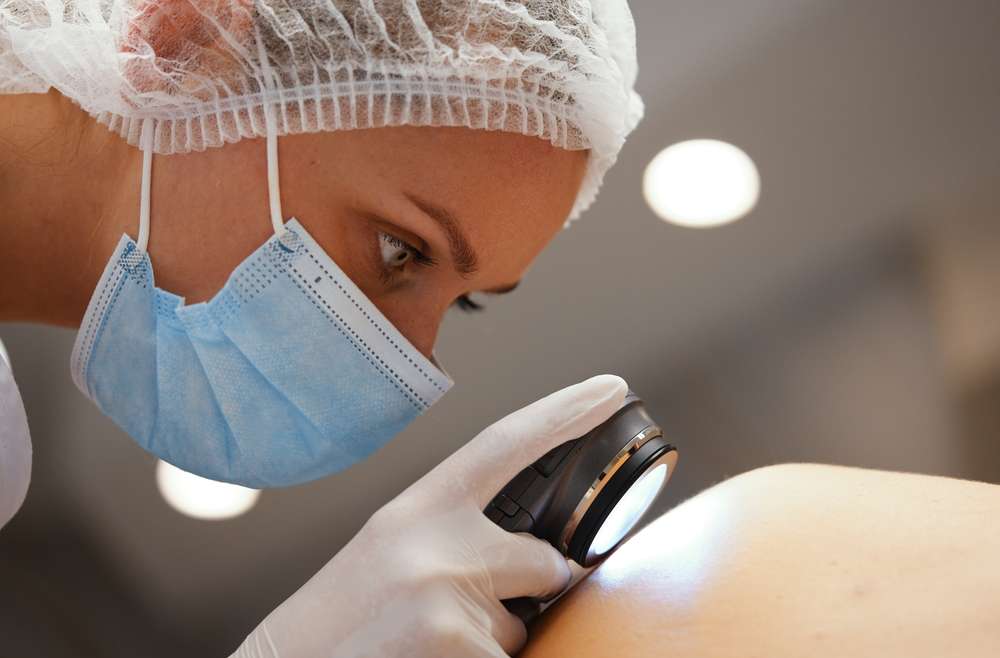
Dermoscopy allows your dermatologist to examine the pigment, vasculature, and other intricate details to make an accurate diagnosis.
In some cases, they may take a biopsy to get more information and know how to proceed in terms of treatment.
Prevention and Annual Screenings Can Help You Reduce Your Risk of Melanoma and Other Types
Annual head-to-toe skin exams by a dermatologist are crucial, as well as:
- Stopping tanning bed usage immediately
- Wearing protective gear, especially during peak UV hours
- Using broad-spectrum sunscreen with a high SPF, even on cloudy days and even during wintertime (and even if you’re indoors but get sun exposure through a window)
- Reapplying sunscreen as directed by the instructions on the product label
Building these habits now can pay off in better skin health and empower you to take good care of yourself.
When You Need a Skin Cancer Screening, Diagnosis, or Any Type of Dermatological Care, Trust Dr. Marjan Yousefi and Team
When should you worry about a mole? There’s no need to worry with Dr. Yousefi and team on your side.
Uncertainty about a mole is always resolved better by a professional evaluation, so don’t put it off any longer!
Call us at 703-255-5070 today to speak with a member of our staff or schedule an appointment online and play a proactive role in keeping your skin as healthy as possible!