
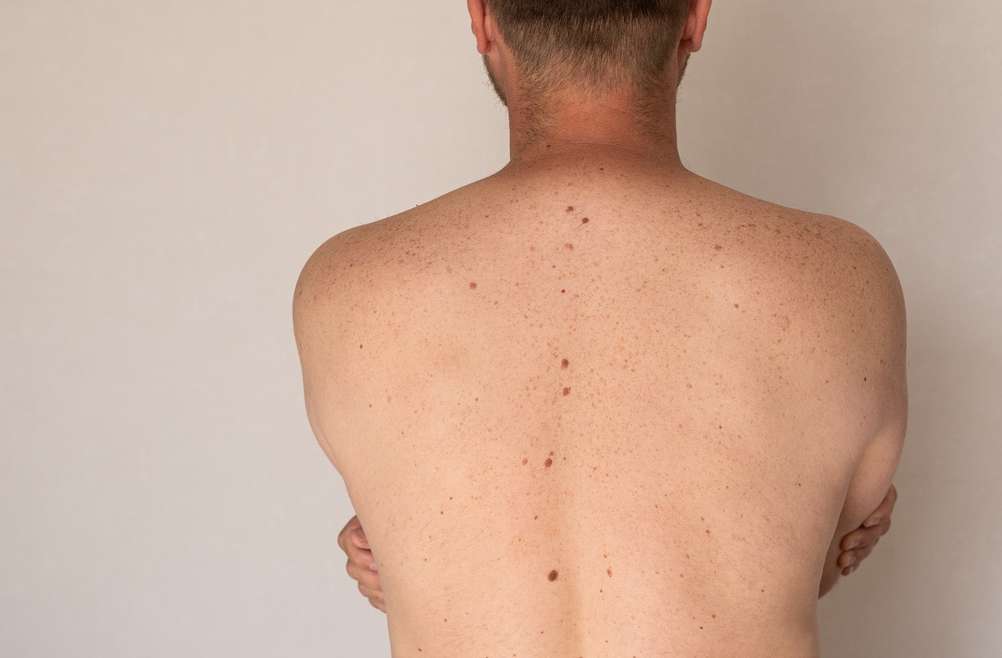
Most people have multiple moles scattered across their skin and don’t give them a second thought.
A dermatologist reads them differently, watching for traits tied to skin cancer risk rather than counting spots.
Multiple moles on their own rarely spell trouble, but certain patterns change that.
Here’s what separates an ordinary mole from one worth a professional look.
Why Count and Appearance Aren’t the Same Signal
A high mole count and an unusual-looking mole point to different kinds of risk.
More moles raise your baseline risk over time, even when they look ordinary. That risk builds gradually and rarely calls for an urgent visit.
An atypical-looking mole can justify a visit regardless of how many moles you have overall.
The Numbers Behind Higher-Risk Mole Counts
Dermatologists rely on a few thresholds to gauge risk from mole count alone.
Multiple moles, generally 50 or more, place you in a higher risk category for melanoma than someone with only a handful.
People with atypical mole syndrome, sometimes called dysplastic nevus syndrome, often have 100 or more moles, including at least one larger than 8 millimeters, or the size of a pea.
Skin tone and mole color can also affect how easy these traits are to spot, which is why a professional exam catches more than a mirror check.
How to Tell an Atypical Growth from a Normal Mole
Dermatologists use the ABCDE rule to separate ordinary moles from ones that need attention:
- Asymmetry: one half doesn’t match the other half
- Border: edges look uneven, notched, or blurred instead of smooth
- Color: multiple shades of brown, black, red, or blue within one spot
- Diameter: larger than a pencil eraser, about 6 millimeters
- Evolving: any change in size, shape, color, or new symptoms like itching or bleeding
A mole that stands out from all your others, sometimes called the Ugly Duckling sign, is worth mentioning even if it doesn’t fit every ABCDE criterion.
Raised or flat doesn’t determine whether a mole is healthy. Some moles simply grow vertically rather than spreading outward.
None of these signs alone confirms cancer. If a mole meets several criteria, a dermatologist may recommend a biopsy to check the cells directly rather than just relying on appearance.
When a New or Changing Mole Raises a Flag
Most people stop developing new moles somewhere around age 40.
A new mole that appears well after that age deserves a dermatologist’s attention, even without any ABCDE warning signs.
The same goes for a mole that starts to itch, bleed, or hurt without an obvious cause.
Multiple moles that all began changing around the same time are worth more immediate attention than one mole doing something on its own.
Waiting to see if a changing mole stabilizes rarely helps and can delay early diagnosis and treatment.
Why the Risk Adds Up With Multiple Moles
People with 10 or more atypical moles face roughly 12 times the melanoma risk of people without them.
A family history of melanoma alongside multiple moles compounds that risk further, even without a formal genetic diagnosis. That combination has a name: Familial Atypical Multiple Mole Melanoma syndrome, or FAMMM, and it carries the highest melanoma risk of any mole-related pattern.
That’s exactly why a full-body exam is more important for some people than others.
Multiple moles don’t automatically mean melanoma, but they do mean more frequent and careful monitoring.
Keep a Simple Log Before Your Visit
A quick log beats memory every time. Jot down when each mole appeared, whether it’s changed in size or shape, and if it itches, bleeds, is tender to touch, or just looks off.
Bring that list to Marjan Yousefi, M.D. at your next visit. She’ll weigh it alongside a full-body exam to decide which spots need closer monitoring.
Call 703-255-5070 or schedule a full-body exam online today. Multiple moles are common. Catching the one that doesn’t belong is what protects you.