
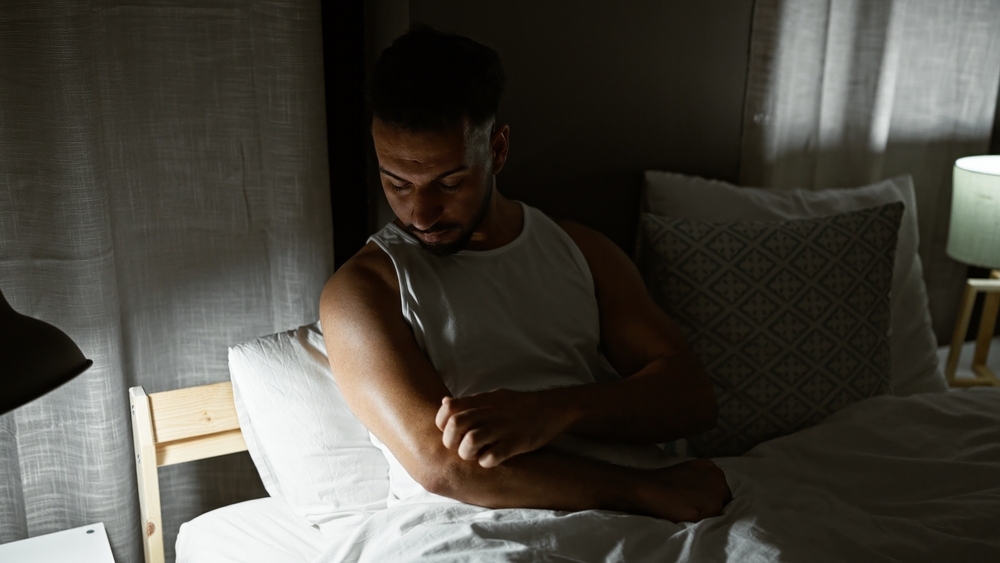
Skin that felt perfectly calm all day can turn maddeningly itchy the moment your head hits the pillow, and the feeling rarely waits until morning to fade. If you have started searching on how to treat itchy skin at night, a dermatology evaluation is often the fastest way to find out why, because this pattern usually traces back to a specific, identifiable cause rather than bad luck.
The itch itself is not random, and understanding what changes in your body after dark makes the pattern much easier to interrupt. Skin conditions, natural changes in your body’s rhythm, and even the temperature of your bedroom can all play a role.
Itchy Skin at Night: Why it Happens + How an Arlington Dermatologist Can Treat It
Your body follows a natural rhythm that changes several things about your skin after dark, including blood flow, temperature, and hormone levels.
Corticosteroids, hormones that naturally calm inflammation during the day, drop off in the evening, while blood flow to the skin increases and brings a feeling of warmth that can intensify itching.
Skin also loses more water overnight than it does during the day, which leaves it drier and more reactive by the early morning hours.
On top of these physical changes, nighttime itself removes many of the daytime distractions that normally keep a mild itch from registering.
These natural changes often compound each other rather than acting alone, which is why occasional itchiness can suddenly turn into a nightly disruption.
Cooling your bedroom and moisturizing before bed can address several of these causes at once.
When Nighttime Itching Signals Something More
Occasional nighttime itching is common, but a pattern that does not resolve on its own is often tied to a specific skin condition. Eczema and psoriasis are two of the most frequent culprits, because already inflamed or dry skin tends to react even more once the skin’s usual nighttime changes are added on top.
Beyond skin conditions, nighttime itching can also point to underlying issues such as thyroid disease, kidney or liver conditions, or an allergic reaction to a medication, detergent, or skincare product.
Itching tied to one of these causes often shows up alongside other symptoms, such as fatigue, changes in skin color, or a rash that does not track back to an obvious irritant.
Occasionally, insects such as scabies or bedbugs are the source, because these pests tend to be most active at night and can cause a distinct pattern of bites or burrow marks.
A dermatologist can usually tell the difference between an insect-related cause and a skin condition with a straightforward exam.
How an Arlington Dermatologist Diagnoses and Treats Nighttime Itching
Diagnosing the cause of nighttime itching typically starts with a detailed history and a skin exam, and may include an allergy test, a skin biopsy, or bloodwork to rule out an underlying condition.
Identifying the actual cause is what separates a treatment plan that works from one that only manages symptoms temporarily.
Treatment often combines a few approaches at once, including fragrance-free moisturizers, topical steroids for inflamed skin, and oral antihistamines that can also help with sleep.
When an underlying condition is responsible, managing that condition directly is usually what finally resolves the nighttime itching for good.
Marjan Yousefi, M.D. is a board-certified dermatologist and an FAAD, or Fellow of the American Academy of Dermatology, credentials that reflect specialized training in diagnosing exactly this kind of overlapping, hard-to-pin-down symptom.
That level of training matters most when a symptom like nighttime itching could point to several different causes at once.
Get to the Bottom of Your Nighttime Itching So You Can Get Some Rest
Itchy skin at night does not have to stay a mystery, and a clear diagnosis is often all it takes to turn restless nights into restful ones.
Contact us online or call 703-255-5070 to schedule an evaluation and start treatment right away. New and existing patients can also book an appointment online