You can often feel an actinic keratosis before you can see it.
More than 40 million Americans develop these rough, sandpaper-like spots each year, and some can eventually turn into skin cancer.
Dermatologists call it a precancer, a growth that is not cancer yet but can become one if left alone.
Care for actinic keratosis in Vienna, VA, starts with a dermatologist checking the spots you see and the ones you only feel.
Rough, Scaly, and Easy to Mistake for Something Else
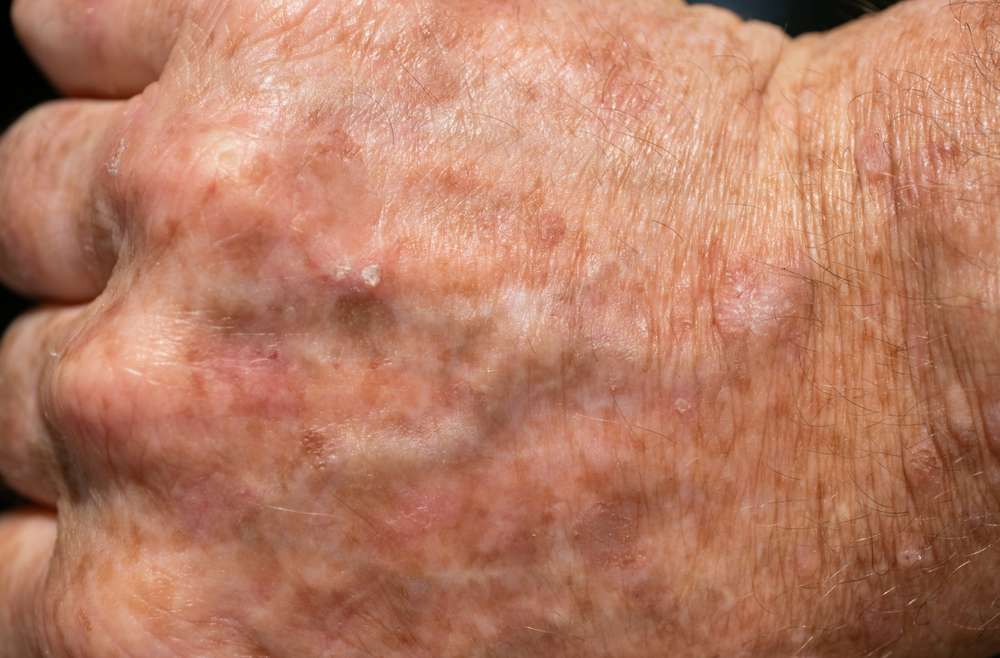
Actinic keratosis varies more than most people expect. Common forms include:
- Rough, scaly spots that are flat or slightly raised
- Pink, red, brown, or gray patches, or ones darker than the surrounding skin
- Hard, wartlike growths
- Spots that resemble acne or a scab that won’t heal
Most are smaller than one inch across. Many itch, burn, sting, or feel tender to the touch.
The Sun Damage Behind Each Patch
Each patch reflects years of ultraviolet exposure from the sun or tanning beds. Even one growth signals badly damaged skin and a higher risk of skin cancer.
Patches most often form on the face, lips, ears, scalp, neck, forearms, and backs of the hands.
Most people who develop them are over 40. Fair skin, frequent sunburns, outdoor work, and a weakened immune system all raise the odds.
A history of actinic keratosis or skin cancer adds to that risk, as does living in a sunny climate. Men are also affected more often.
How a Precancer Can Become Skin Cancer
Not every actinic keratosis becomes cancer. Left untreated, about 5% to 10% may develop into squamous cell carcinoma, which is usually treatable when caught early.
Dermatologists cannot predict which spots will make that change. Once a spot is removed, though, it can no longer become skin cancer.
Any scaly spot that persists, grows, or bleeds deserves a closer look, because harmless and cancerous spots can be hard to tell apart.
Treatment Options for Actinic Keratosis in Vienna, VA
Diagnosis usually involves a skin exam, sometimes with a magnifying tool known as a dermatoscope. A biopsy may follow when a spot looks suspicious or hard to classify.
Common treatments include freezing a spot so it falls off, applying a specialized light, or using a prescription cream at home.
Skin with many patches, including ones you can feel but not see, may need a combination of treatments or repeat sessions. Combining approaches can address visible and hidden patches together and lower the risk of skin cancer.
Treatment for actinic keratosis in Vienna, VA, also relieves the itching, tenderness, and bleeding these spots can cause.
Protecting Your Skin After Treatment
Most treated spots heal within a few weeks, though new ones can form.
Daily sunscreen with SPF 30 or higher, including on your lips, helps prevent new patches. Sun protection also gives your skin a chance to repair some existing damage.
Wide-brimmed hats and protective clothing add another layer of defense, as does skipping tanning beds.
Skin checks once or twice a year help catch new patches, along with skin cancers such as melanoma, while they are most treatable.
From Fingertip Check to Dermatologist’s Exam
A fingertip can find a rough patch. Telling a harmless dry spot from an actinic keratosis, or a precancer from early cancer, takes a dermatologist’s exam.
Dr. Marjan Yousefi earned her medical degree at George Washington University, just across the Potomac. Today, she examines sun-damaged skin from scalp to hands, looking for patches that need treatment.
She sees people for actinic keratosis in Vienna, VA, at the Boone Boulevard office, with a second location on North Pershing Drive in Arlington, VA.
Trust What Your Fingertips Tell You
A rough spot you keep running your fingers over has earned a dermatologist’s attention, especially when it lingers or bleeds.
Call 703-255-5070 to schedule a full-body skin exam in Vienna, Virginia.
Online scheduling is open around the clock for new and returning visits. You can also reach the office with questions before your appointment.
Meet Your Dermatologist for the Various Skin Cancers: Marjan Yousefi, M.D., FAAD
Dr. Marjan Yousefi is a board-certified dermatologist and Fellow of the American Academy of Dermatology (FAAD) providing medical, surgical, and cosmetic dermatologic care across Northern Virginia, with modern offices in Arlington and Vienna.
Distinguished Education & Oncology Fellowship
- Medical Degree: The George Washington University Medical Center (with undergraduate studies at GWU and a focused study year at Oxford University).
- Dermatology Residency: Geisinger Medical Center.
- Specialized Fellowship: Completed an elite Melanoma Fellowship at the Washington Cancer Institute.
Comprehensive Skin Health & Aesthetic Precision
Dr. Yousefi combines rigorous clinical dermatology with non-surgical aesthetic rejuvenation, tailored for pediatric and adult patients:
- Medical & Surgical Dermatology: Expert skin cancer screenings, melanoma management, surgical excisions, psoriasis therapy, and advanced acne treatments.
- Cosmetic Injectables & Lasers: Subtle facial rejuvenation with Botox®, Dysport®, Juvéderm®, Restylane®, and Sculptra®, paired with Sciton Halo®, MicroLaserPeel, and BroadBand Light (BBL™) therapy.